Imagining A Post-Scarcity Society in Your Adventures
If money didn't exist in your setting, what would your players actually fight for? Post-scarcity societies imagine a world beyond gold pieces and imperial credits.

The term “post-scarcity” often brings to mind a utopian future, one where money no longer decides who gets to love comfortably, and where hunger, homelessness, and lack of access to basic welfare needs like healthcare are problems of the past. Private ownership still exists, but mostly in small, personal ways. Relationships and identity matter more than the accumulation of resources.
As a setting idea, post-scarcity assumes that the technology or magic of the age has made survival easy. Food is plentiful and energy is abundant—yet people are still people. They still disagree, still want things, and still come into conflict. The struggle just stops being about survival.
At first, worlds like these sound almost too perfect. But once I started thinking about it as a TTRPG setting, I hit a wall. If money no longer matters, what motivates player characters? What does adventuring look like when survival is guaranteed?
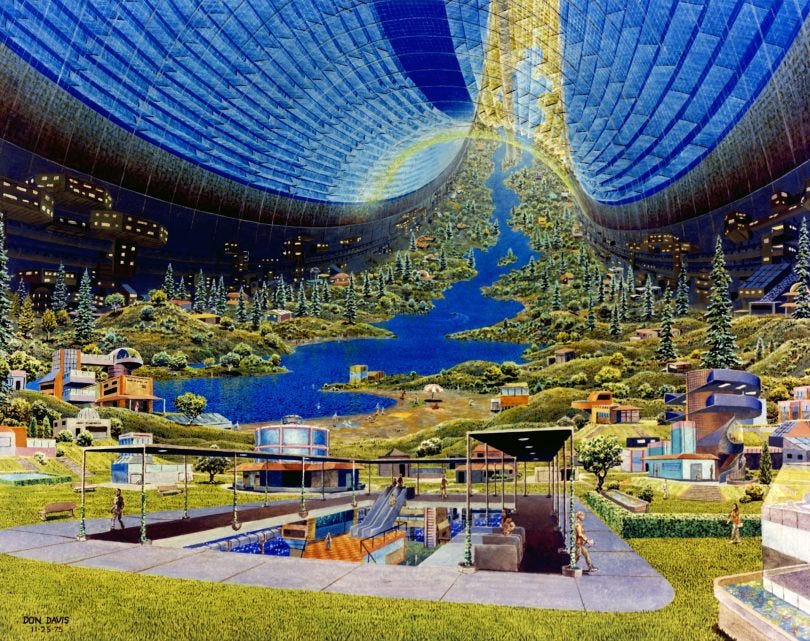
A World Beyond Resources
I first got distracted by this idea while I was watching an Isaac Arthur video on YouTube on post-scarcity civilizations, and some examples of sci-fi works that use this economic paradigm as the baseline of the society of their settings.
The first, and most well-known example would of course be Star Trek. Throughout almost all of Star Trek’s media, replicator has always been a staple part of the setting. Despite all of the technobabble and pseudo-science explanations provided to rationalize how it works, one thing remains clear: it gives out things people need for free.

At first, the idea seems simple and straightforward: people don’t need to pay for things anymore. But when I started to revert to my 21st-century humanoid mindset, I immediately got hit by a minor existential crisis. More accurately, my hustle and GSD grindset finally met its match.
The first thing on my mind is an amalgamation of a couple of things, namely: “How?”, “Now what?”, and “Why?”.
For starters, the how of it all is by what means does everyone, and I mean every being in the United Federation of Planets in Star Trek, agree to decide that money does not matter anymore. Following up on that is the second question. Now that money doesn’t matter anymore, then what? What do people strive for? And finally, the last thing I wondered is why do people in Star Trek decide to continue down this path? Isn’t capitalism and mercantilism the ultimate goal of opening up new frontiers and markets?
Well, the answers to those questions were sadly quickly answered when I was reminded of the glory and hubris of one of the GOATs of ancient aliens, the Aeldari Empire—the space elves of Warhammer 40k.
To those uninitiated to the franchise, the Aeldari (or Eldars) are a race of humanoids made by an ancient being a long, long time before humanity even lit their first fire. In short, they managed to achieve a golden age, when they weren’t busy themselves anymore with surviving, and just enjoyed thriving. They became a hedonistic race that collectively descended into creatures of pure desire, which ultimately gave birth to the chaos god Slaanesh.
That made me realize that there’s one point in the Eldar History where they strove not for self-fulfilling goals, but more communally evolving themselves. This point in their timeline, I hypothesize, is the very same one that the folks of Star Trek is currently going through.
As the Reddit user foxwilliam wrote in his fantastic blog-like post, Star Trek’s society is not merely Post-Scarcity, but it is Post-Greed. At this point, humanity (and the other Federation non-human species) collectively decided to “work together for the betterment of everyone rather than for each person’s individual gain,” as written in the post.
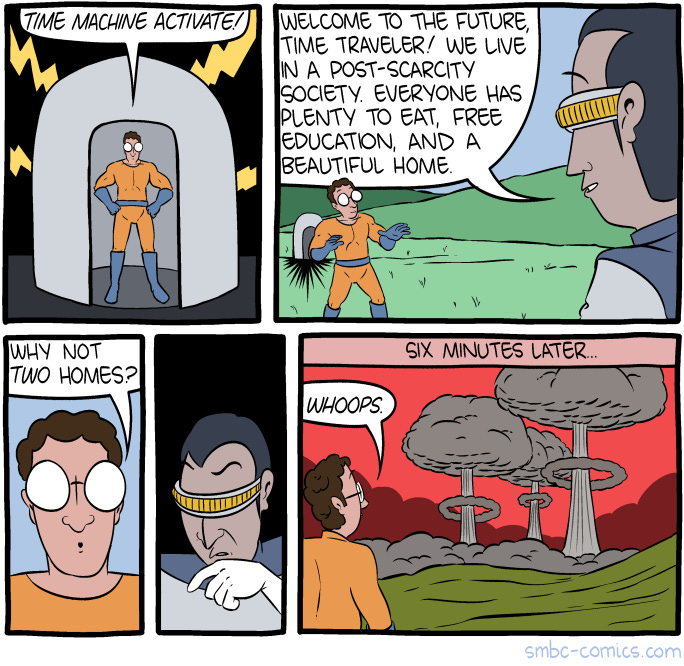
There are, of course, other examples of civilizations and races across sci-fi works that exhibit examples of post-scarcity civilizations. One that quickly came to mind is the Galactic Empire of Isaac Asimov’s Foundation series, or maybe even humanity of the pre-imperial era of Warhammer 40k. But, unfortunately, I haven’t really gotten around to delving too deep into these examples, so I would just stick with the ones I’m familiar with.
(By the way, since I’ve mentioned a lot of Isaacs in this post, I feel like I’m obliged to give a shout out to the amazing blog of one of my closest TTRPG Friend, Afraid of Encounters. Go check it out!)
Building a Post-Scarcity World
Before we start, a caveat: post-scarcity is not reserved only for the science fiction genre. The fantasy genre can easily have its own post-scarcity civilizations.
On top of my head, the likeliest example would be either magocratic civilizations, where magic has replaced most of the need for most resources & human labor (Another one of my friends, Habeeb explored this topic, as well as its political consequences in his blog post!), such as Thay and Netheril of Forgotten Realms (people may want to correct me on that last one)—or divine/mythic utopias, like the gods of Olympus.
To begin with, at its core, a post-scarcity setting is one in which basic material needs. Food, shelter, healthcare, and energy are all so easy to produce that they’re effectively free to all. Now, this doesn’t mean that there are no conflicts (remember that an effective worldbuilding for TTRPG needs the setting to not be in a status quo), only that the traditional economic struggles are not the primary drivers of society.
To take the previous examples I mentioned, in Star Trek, replicators and near-limitless energy may allow characters to focus more on diplomacy, exploration, and culture instead of survival.
Personally, I’ve always told myself, “if money wasn’t a problem…”. The continuation of that phrase would serve as a great primer for whatever goals you think people of your post-scarcity world would pursue. Think about the goals you could achieve if you don’t have to worry about your day job or paying for the resources you need to pursue that goal.
One question that may pop up again and again as you think about this world is “if stuff is everywhere, what do people do?” Here are some examples of motivations I thought up while writing this article:
Status economies: People compete for prestige, influence, reputation, or even access to rare cultural experiences instead of traditional survival needs.
Creative labor: Work becomes something people do for fulfillment, not survival.
Purpose conflicts: Struggles emerge over meaning, identity, or existential threats instead of shortages (this is what Star Trek TNG does in many of its episodes featuring Q.)
Relationships: A more lite option for conflicts, if you want to focus more on the stories of individual people instead of the civilization itself.
There are other purposes that are more direct and less complex, but still work nonetheless, such as boredom, simple desires, and cultural responsibility. Funnily enough, you just have to look at what rich people do nowadays to think up how post-scarcity societies operate. Alternatively, you can also read some Wuxia works that feature characters of higher social status or are plain overpowered. They work as well, too.
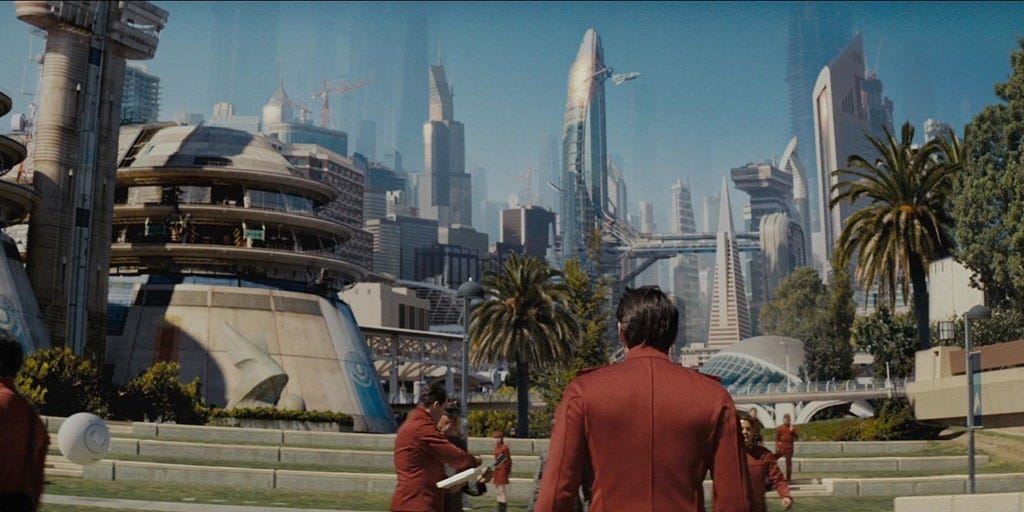
Now that we’re done with the foundations, it's time to visit potential drivers of narrative tensions that are usually filled by material scarcity.
In place of more traditional drivers of dramatic tensions, such as capitalistic tendencies, personal greed, or the lack of survival means, post-scarcity worlds usually rely on the more abstract values and aspects of human life that are often considered as tertiary. Face becomes more important than wealth, and collectivism means threats usually come from outside of the homogeneity.
Here are some examples I thought of to show you what these potential drivers can look like:
Social scarcity: Reputation, cultural capital, or political power.
Resource bottlenecks: Rate art or spiritual objects, or maybe some elite access to certain tech.
External threats: Alien conflicts, existential risks, or ideological schisms from recently introduced ideas.
Post-scarcity civilization is not always one that’s already reached its pinnacle. Sickness may still, and death haunts the people of such civilization still. Distance and time may also still be the greatest barrier to be overcome by such civilization, as even collectively, human may still find faster-than-light travel to be a mystery. Heck, the civilization may even have relied on technology that they have not truly understood, and their status quo may be challenged sometime soon.
The technology, magic, or anything that sustains the paradigms of a post-scarcity society does not change the world overnight, either. Generations have to pass before everyone can collectively accept that there is simply no need to hoard personal wealth anymore, because everyone is equally rich and equally poor. Just like how it has throughout history, it may not last forever either. At one point, humanity may realize that even the unlimited has its limits, and decides to hoard anyway.
There’s a lot of ways to combine these motivations and narrative tensions to build a plausible, but still narratively interesting post-scarcity worlds. However, it is also important to think about how the individual pieces would find a role and navigate through this world. What is the point of player characters if the human collective decides that they can create a large, specialized task force instead of just sending 4 adventurers to solve their problem? Remember that the Corporation in industrial sci-fi can definitely send more than just 4 space truckers to retrieve the alien eggs if it has the resources and means to do so every time.
And one last thing to remember: a post-scarcity society is not a hive mind. In fact, at this stage of civilization, ideologies may vary wildly, even among the same group of people. Now that there’s little need to congregate just for the sake of getting their voices heard, many would strike out on their own, creating their own group.
No Money, No Problem
I wasn’t exactly thinking about game design when I first started writing this article, but then I realize how much TTRPG often revolves around earning and spending one kind of resource or the other. Gold pieces, dollars, credits, you name it. But, it doesn’t mean that we can just do away with resource and tool acquisition in such a setting. In fact, there are already some RPG systems that use this kind of mechanics to arbitrate obtaining equipment for your characters. I’ve probably been just constrained by a more traditional RPG framework to realize that not all TTRPG systems use currencies.
First example of a system would be the first example of this article: Star Trek—more specifically, the 2d20 Star Trek Adventures system by Modiphius Games. Instead of currencies, equipment is paid using “opportunity” and “escalation” costs. Opportunity cost is paid by spending “Momentum”, a player resource that represents the most expensive currency of all: Time. This basically shows that even free, they still need time to be obtained. The other cost, escalation, is paid by increasing “Threat”, which is the GM’s resource used to increase difficulty or create complications, which represents that by having players introduce new weapons and dangerous tools of destruction, the more threats are presented to the situation. In this case, equipment acquisition represents a natural narrative progression.
Another example from systems that are arguably not set in a post-scarcity setting is the LANCER RPG. Instead of having to spend credits to buy mech parts, players have to obtain “Licenses”, which allows the player to use parts from certain mech designs, and that not all of them is unlocked just by obtaining that license. In a post-scarcity world, this example could be implemented as a system that gradually opens up access to higher and higher grades of weapons as a player character gain reputation or rank in a society or institution. Narrative gear is assumed for pilots. In this example, progression replaces economics.
Another example is Call of Cthulhu 7e, which presents us with the Credit Rating skill. When you have access to your assets, most of the time, exact amounts of money is not tracked when you’re spending them. The Credit Skill works by representing the overall of your character’s income level, social class, access to goods and services, as well as their lifestyle. You use it by both comparing it or rolling against it when making purchases: Trivial purchases you can waive, significant purchases can be done once in a while, while major purchases require you to roll. For our setting, however, this mechanic and the skill may represent the currently available resource that your character can access overall. Again, maintaining order in a society still means that while everyone can still survive equally, it doesn’t mean everyone lives equally. For this example, resources become a bit more abstract, allowing players to more correctly represent what their characters may be able to acquire, and the limits of such access.
If you still feel the need to have a more concrete tracker for resources and expenses, here are some options that you can use to replace money:
Permission (you can because of who you are)
Access (you can because of where you are)
Reputation (you can because others trust you)
Prep/Load (you can because you planned ahead)
Narrative truth (you can because it fits the story)
These options dovetail perfectly with post-scarcity settings and ideology-driven societies. Focus on moving away from the limitations of your characters, and drive the story towards a grander plot point. At 5e or Pathfinder 2e, shopping may be a session itself, but in a post-scarcity game, it becomes much more trivial. Travel is less of a hassle, since you’d have all the food, water, and fuel you need anyway.
Moving Ever Laterally Forward
A post-scarcity society is truly the stuff of speculative fiction. Looking at the state of the world now, it’s really hard to imagine whether we will ever achieve this state of utopia in our lifetime. That’s why I believe it’s best to continue to keep in mind that, yes, building up personal wealth is overrated.
Some common pitfalls in designing such a world include the possibility of stagnation, where we revert back to a more traditional, scarcity-based stakes that we see underlying almost every issue we see plaguing the news. Another one is missing the cultural nuances of a post-scarcity culture. It’s not just a place with “infinite loot”. Don’t kill the value just because everything doesn’t have any. What they don’t pay in money, they pay in time, conflict, and limitations. As such, don’t forget to set expectations early. Let everyone at the table know why scarcity is absent and why conflict still exists.
While personally, I’ve never dabbled too deeply into creating a post-scarcity work, I used to work on a personal project from a time when I was deep in the Wuxia rabbit hole. The setting’s tentative name was Starlight Sovereign, combining sci-fi and cosmic-level Xianxia. In this setting, even the resources are sentient (the explanation is that a self-governing blockchain infused with the soul of a dragon is tracking every transaction made), with money able to spend and arbitrate itself to the point that everyone no longer cares about their earnings and expenses.
Stay distracted, friends!